
Why Imitating Other Artists Is Better Than Investing In Courses
Stop wasting your time and money on endless "how-to" courses that leave you feeling more clueless than when you started. In this post, we’re diving into why replicative learning—or the art of imitation—is actually the ultimate shortcut to mastering creative tools like Photoshop or Procreate, or specific styles and techniques.
ART & DESIGN
Leigh-Anne Grey
4/1/20265 min read
When I left school at seventeen, I secured a multimedia apprenticeship—a rather informal one, but an opportunity nonetheless. When it came to learning the basics of graphic design and tools like Photoshop, my mentor would task me with a rather unusual assignment at the time.
Back in 2007, you didn’t have access to endless catalogues of courses and tutorials made by independent teachers like you do today. If you wanted to learn something, you typically went through some type of formal system or education—or you read a book. But what he would have me do is something he used to do when he was a student—he would pick out a professional design someone else had already made, and he would task me with replicating that design using the relevant graphics tool.
You know, of all the educational lessons I’ve been taught in my life, I only vividly remember two. The first was from my computer teacher, who said there’s no right or wrong way to get the right answer for a computer test. “If you’re smart enough to know how to use a computer to find the answers you need, then you’re clearly using the computer right.” I’m paraphrasing, but that was ultimately her point. It was the first time I’d been given permission to “find and intuit answers” rather than be instructed to follow a predefined path that resulted in unavoidable consequences if not, just because those were the rules of the curriculum.
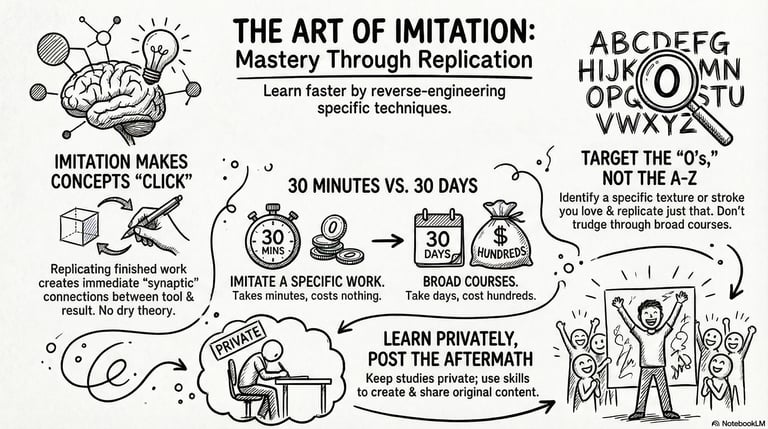
Being told to replicate someone else’s finished work was the second lesson I vividly remember. I remember the way everything would just click—how the synapses would sing—as I would produce something that looked exactly like the thing I was trying to imitate. There was no theory, no textbook, yet I learned both graphic design concepts and the key components of the software tool itself all at once, with immediate, positive affirmation, as I could see the results lining up with the goal as I worked. I’ve only used Photoshop a handful of times since, yet I never forgot how it worked.
Both of those lessons have a strong message in common: getting the answers (figuring something out) is not contingent upon someone else explaining one very specific or “ordained” approach to you. You can figure it out yourself, even if someone with the right “expertise” doesn’t explicitly walk you through it.
The work I did in the years that followed was more logical and analytical than creative, though, and by the time I eventually began to miss more creative projects, it was hard to break out of a linear way of thinking. Coming from a world of logical thought processes in my everyday work made the concept of art in various styles using various mediums too broad and too lateral a concept to wrap my head around.
So even though I remembered how effective the concept of imitating another designer or artist was, I was simply too overwhelmed by the anti-linearity of the creative world, and I wasn’t confident enough to rely on such a straight-forward, self-reliant approach again. So instead I spent a lot of money—and even years—buying course after course, book after book, and subscription after subscription. You know where they all got me? Nowhere.
I felt directionless and somehow always ended up back at square 1, feeling just as unconfident and clueless. After all those hours of taking in "how-to"s, I still couldn’t navigate my own artwork. Because art was too expansive a subject to navigate on my own without someone to hold my hand and guide me through specific steps each time. Given how much time and money I had already invested, that seemed… backward.
So my advice to you is to consider this: if you want to learn a tool like Procreate, how do you choose a course? After price (because we all have a budget), you likely look at reviews. But say two courses both have equally great reviews; what do you look at? The chances are you look at the artwork advertised throughout the course—what the teacher has you create. If the artworks in the course resonate more with your style, you’ll likely go with that course because it’s natural to assume the course will teach you how to create in a style that speaks to you while you simultaneously learn how to use Procreate.
But looking back, have you ever actually found that to be the case? You may have successfully learned how to use Procreate, but the secrets behind achieving the style weren’t necessarily mastered. Likewise, you can purchase a course specifically to teach you how to achieve a certain style but find that the teacher chose to focus heavily on applying that style to trees or flowers specifically when you were hoping to be able to understand the global techniques for that style as it applies to any subject matter.
My point is, you’d be better off finding art that inspires you and identifying whether it’s everything about that art piece that you love or something specific—like the color, texture, layering, brush strokes, or even shape language—and trying to replicate that either digitally, traditionally, or both, depending on the scope of your artistic interests.
Because sometimes, it’s something as simple as the transition from solid shapes to brushy strokes, and the part your brain is struggling with is how to achieve that using a specific medium or, in the case of a digital tool, how to achieve that with the right brush shape, brush settings, and movements.
What course would you buy that specifically deals with that exact textural transition? A course centered on Procreate itself would go far beyond that scope and may not even touch on that very specific textural use case. A course on a similar style may go over the basics of the style as a whole, briefly mentioning that technique in passing, without showing you how to achieve it in a digital tool like Procreate or the specific medium you prefer to use. It gets even worse when you consider that a course can range, on average, anywhere from $30 to $150.
But to imitate that work can often take less than 30 minutes, cost you nothing, and teach you the exact thing you were hoping to learn. You won’t oversaturate your brain with the A-Z’s when all you were looking for was the "O's," and you can immediately move on to the next thing, building up your repertoire in a matter of hours, rather than trudging through one very broad course over a few days before investing in another and repeating the process, retaining very little as you hunt for that very specific, niched skill you were looking to master in the first place.
Does that make sense? Please don’t post your studies if the original artist hasn’t given you permission to do so, but also remember that not everything belongs on social media. It really doesn’t. Learn in your own time, and rather post the aftermath—the new subject matter you were able to produce using this newly acquired skill. That's original content and doesn't require permission.
There's a time and place for courses if you know what you're looking to learn and know exactly what they're offering. But usually, and most often the case, you have the opportunity to save your money. Rather than invest in someone else's course, invest in yourself instead.